The Ideal Hair Color and Personal Color Analysis


🎨 The Numbering of Hair Dyes and Their Direct Relationship with Personal Color Analysis
When we talk about hair color, it’s common to think only in terms of shades — blonde, brown, redhead…But behind every dye, there’s a precise numerical structure that defines three fundamental factors: depth, temperature, and saturation. And the most fascinating part? These same three factors are exactly the three stages of personal color analysis.
1️⃣ The First Number: Depth
The first number (before the period) indicates the level of depth of the color — in other words, how light or dark it is.The international scale goes from 1 to 10, where:
1 — Black
2 — Very dark brown
3 — Dark brown
4 — Medium brown
5 — Light brown6 — Dark blonde
7 — Medium blonde
8 — Light blonde
9 — Very light blonde
10 — Extra light blonde
In personal color analysis, this step corresponds to observing the depth or contrast between the skin and other elements of the image.
👉 In hair dye, it translates into how much the hair color creates contrast with the face:
Dark shades can feel heavy on low-contrast complexions.
Very light shades can wash out medium and deep complexions.
The secret lies in the balance between depth and contrast.

2️⃣ The Second Number: Temperature
The second number, which appears after the period, represents the undertone or reflect — in other words, the temperature of the color. Here we enter the world of warm and cool tones, exactly as in the first stage of personal color analysis.
The main reflections are:
.0 — Natural
.1 — Ash / Cool
.2 — Iridescent / Violet (cool)
.3 — Golden (warm)
.4 — Copper (warm).
5 — Mahogany (warm).
6 — Red (warm).
7 — Matte / Greenish (cool)
.8 — Pearl (cool)
👉 A 7.1 (medium ash blonde) is cool.👉 A 7.3 (medium golden blonde) is warm.
Just like in personal color analysis, temperature is the first big divider: half of all dyes are warm, and half are cool. Knowing your skin undertone — warm or cool — already eliminates half of the wrong options.
3️⃣ The Third Number: Saturation or Intensity
The third number (or the second after the period, in codes like 7.34 or 6.45) defines the intensity and mix of reflections. It corresponds to the saturation of the color, which in personal color analysis is the final step to confirm your palette.

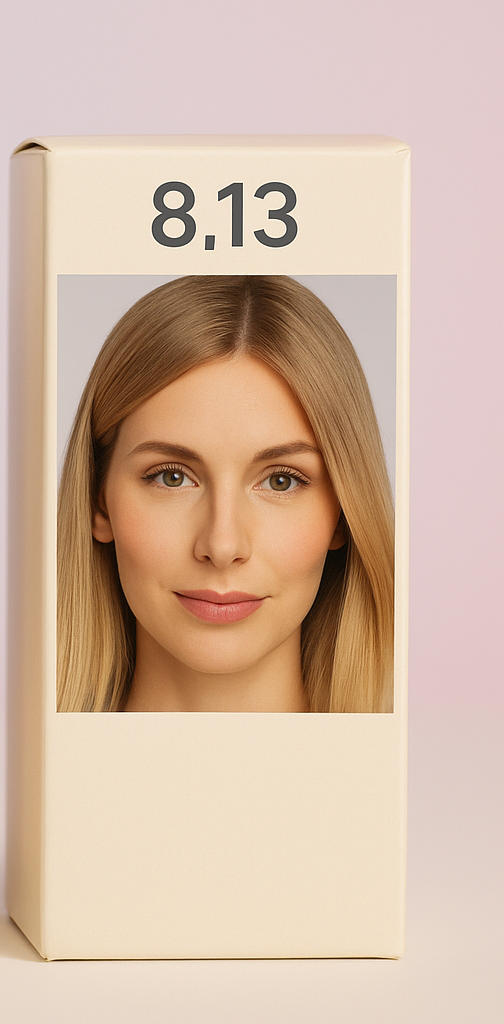
👉 7.34 means medium blonde with intense golden-copper reflections.👉 8.13 means light blonde with soft ash-golden reflections.
Here, the goal is to evaluate how much color intensity the hair can hold without losing harmony.People with soft palettes (like Soft Autumn or Soft Summer) look more balanced with subtle reflections and desaturated tones. Those with stronger palettes (like Warm Autumn or True Winter) can handle more vibrant colors and pronounced reflections.
💡 The Connection Between Hair Dyes and Personal Color Analysis
These three elements — depth, temperature, and saturation — are the same principles that guide personal color analysis. The only difference is that, in consulting, we don’t look at the dye number itself, but at the visual response of the color-light on the skin.
That’s why understanding the logic of dye numbering is essential:👉 Once you’ve discovered your color palette, you’ll know exactly which hair dyes and tones harmonize with your face, without testing dozens of options.
✨ Technique with Sensitivity
In my work, personal color analysis goes far beyond aesthetics — it’s about strategy and self-knowledge, especially when combined with visagism and style composition (complete consulting).Hair color should illuminate your face and express who you are — without losing naturalness or becoming a victim of trends.And that’s only possible with technique, sensitivity, and respect for your essence.


Comments